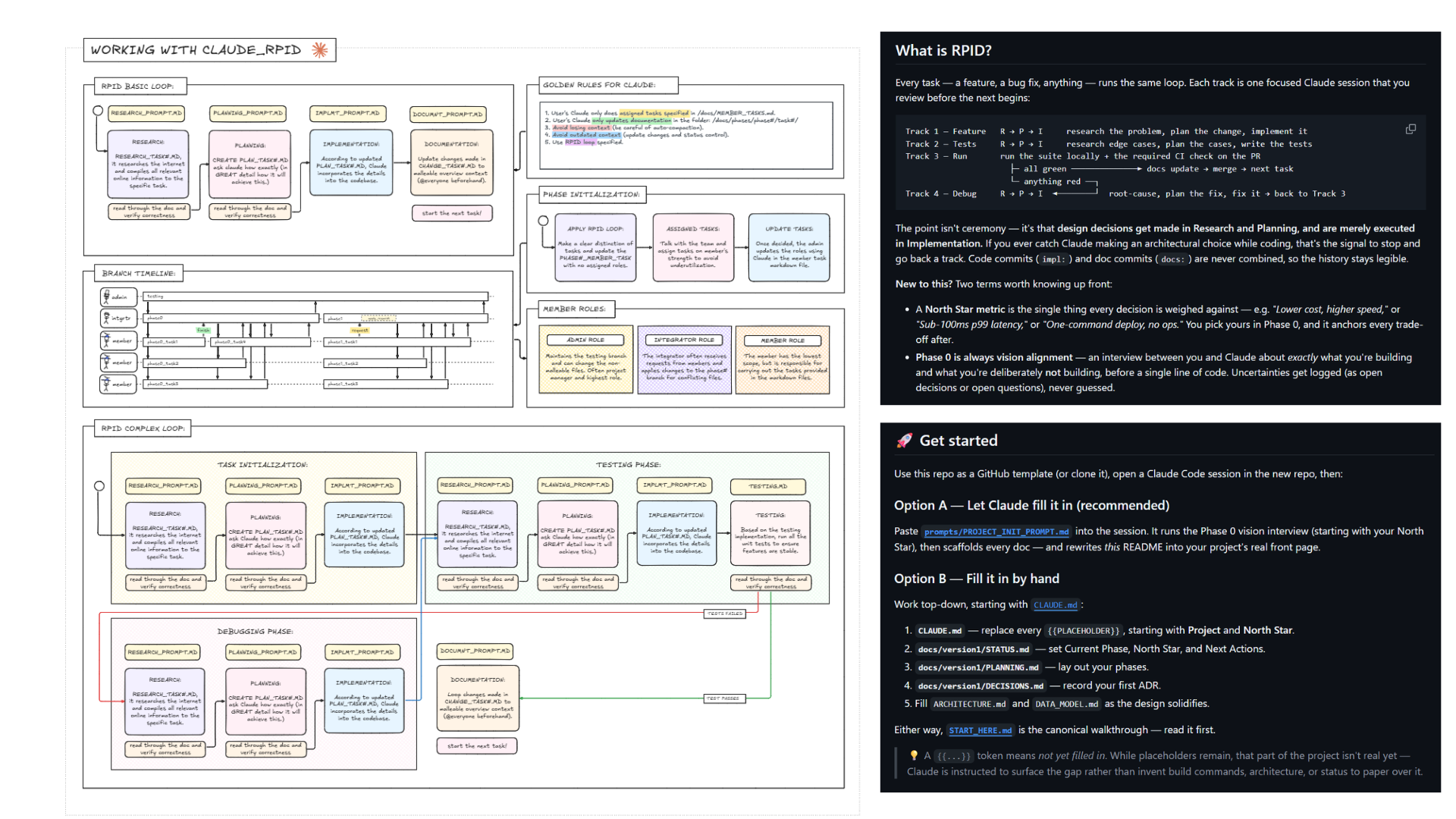
AI coding agents write fast but forget. ClaudeRPID is a stack-agnostic project template built around a single premise: lost context and outdated context are the only real enemies, and every rule in it kills one of the two.
The loop
Every task runs the same four tracks — Feature and Tests each as Research → Plan → Implement, a Run track for the local suite plus a required CI check, and a Debug track that loops back on a failure. Decisions get made and written down in Research and Planning, then merely executed in Implementation. Catch the agent making an architectural call while coding, and that’s the signal to stop and go back a track.
Phase 0: vision before code
Every project opens with a vision interview that pins down what’s being built — and what’s deliberately not — anchored to a single North Star metric that every later trade-off is weighed against. Uncertainties are logged as open decisions, never guessed.
Living docs as memory
The backbone is a set of documents that travel with the repo and stay current: STATUS, DECISIONS (an ADR log), ARCHITECTURE, DATA_MODEL, PLANNING. STATUS.md is read at the start of every session and rewritten at the end, so a cold start finds its context on disk instead of lost to the last conversation.
Commit discipline
Four commit types — impl:, test:, fix:, docs: — are never combined. The history stays legible: you can always see where a decision was made versus where it was carried out, and the malleable docs stay in lockstep with the code.
Also in the box
- A prompt library — three task modes plus a tailored prompt for each RPID track.
- A GitHub Actions test gate — a required check, so nothing merges on red CI.
- Solo mode by default; a full team model (roles, branch hierarchy) sits dormant behind a flag.
- Opt-in profiles for language/framework tooling, so the core stays stack-agnostic.
What stuck
Most of an agent’s mistakes are really context mistakes. Force decisions to be recorded and kept fresh, and a lot of “the AI did something dumb” quietly disappears. The discipline lives in the scaffolding, not the model.